ML & MLOps
Commercial ML — one year on contract (Chemwatch, 2021–2022); since 2025 I have built my own ML systems from data collection to a service on Kubernetes. Each project below shows its result and what it does not have yet. SoccerPredictAI, CAE Copilot, the agentic process, the platform and Ash are personal projects; Chemwatch was contract work.
Projects
SoccerPredictAI — Football Match Outcome Prediction
v1: May 2025 – May 2026; v2 in progress | Personal project | soccer.dmitryivanov.dev MLOps XGBoost MLflow DVC FastAPI Kubernetes
SoccerPredictAI — Football Match Outcome Prediction
v1: May 2025 – May 2026; v2 in progress | Personal project | soccer.dmitryivanov.devA personal project built to go through the whole path of an ML system myself: from scraping data to a service on Kubernetes. The data is 950,000+ matches scraped from one statistics site.
v1 result on the holdout set
| Metric | Value |
|---|---|
| Holdout set | 135,970 matches from 2024 |
| Log-loss | 1.006 (frequency baseline 1.071, uniform 1.099, bookmaker ~0.97) |
| ROC AUC | 0.643 |
| Calibration (ECE) | 0.004 |
| Flat-stake betting simulation | −0.7% |
| API latency (p50) | ~126 ms — local test (WSL/Docker), conditions in the report |
| Tests | 564 |
| Infrastructure | one self-hosted server, under €30 a month |
What it means. The model is well calibrated and beats the frequency baseline, but the market is more accurate. The error differs by segment: with an Elo gap above 300 log-loss is 0.632, in even matches (gap under 50) it is 1.061. The model’s advantage on segments was not assessed: there is no baseline on the same segments.
Pipeline
Scraping → PostgreSQL / MinIO → Great Expectations (data quality)
    → features (rolling statistics, Elo ratings)
    → model selection on walk-forward cross-validation (MLflow) → XGBoost tuning in Optuna
    → final training → holdout evaluation (once) → MLflow registry
    → FastAPI → Kubernetes + Helm → Prometheus, Grafana
I wrote the SQL queries to PostgreSQL (joins, aggregations) myself.
v2 — in progress
Since September 2026 I have been rewriting the system with the agentic development process: as v1 expanded (MLflow, Prometheus, Grafana, Evidently…), maintaining its components became harder, and it became hard for one person to keep training, monitoring and model quality connected. Drift monitoring (Evidently) is in progress.
Docs
- System overview, results and demo walkthrough: docs.soccer.dmitryivanov.dev
- Pipeline reports (Quarto): stages 01–07
- Reproduce (
dvc pull→dvc repro→mlflow ui): the Quickstart section of the docs; full reproduction needs access to the data storage, the evaluation reports are public
Key Engineering Decisions
- No leakage: models are selected on temporal (walk-forward) cross-validation with folds split by match start time; features (Elo, rolling statistics) use only matches before the prediction date; the holdout set is scored once, in a separate stage
- Bookmaker odds are not features: they are collected from 2 sources only to compare with the market and simulate betting
- Data quality checks: Great Expectations suites on the data layers — the pipeline stops on a schema violation
- Reproducibility: a 22-stage DVC pipeline; experiments and the model registry in MLflow
- Service: FastAPI on Kubernetes; the async mode (Celery/RabbitMQ) is not finished
Verify this project
Architecture, monitoring and quality gates are in the docs.
Chemwatch — Data Extraction Prototype for Safety Data Sheets
Jan 2021 – Jan 2022 | Contract | Remote, Australia OCR Clustering Classification Python
Chemwatch — Data Extraction Prototype for Safety Data Sheets
Jan 2021 – Jan 2022 | Contract | Remote, AustraliaProblem. Chemwatch (Australia) maintains a database of chemical safety data sheets (SDS/MSDS). Composition data (ingredients, CAS numbers, proportions) was typed in by hand — from scans and unstructured PDFs. The client needed a working prototype to show management that this could be automated.
How I worked. Alone, on contract, alongside my main job; the client reviewed my progress and deliverables each week.
Method.
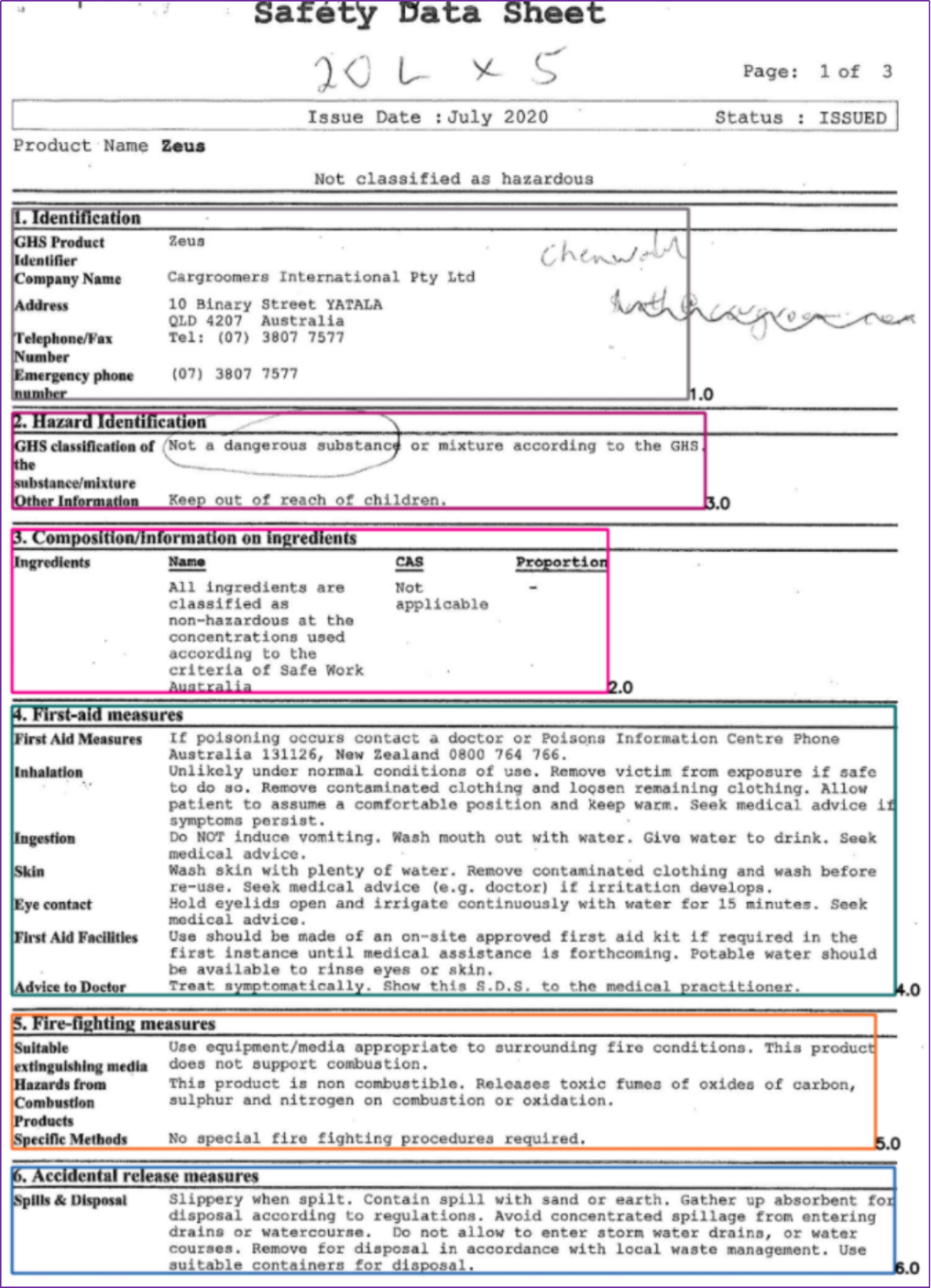
PDF / scan → OCR (AWS Textract) → page objects (JSON)
    → clustering: headings · tables · paragraphs
    → finding the composition section (clustering + classification)
    → extraction → CAS number check against a public registry
    → confident: to the database · unsure: to a human
Result. On a validation set of ~1,000 documents, 95% were extracted correctly — checked by hand; correct means all ingredients found and none extra. The algorithm itself flagged the other 5% as not found and routed them to a human. About 50,000 documents were then run through the prototype without spot checks.
Limits. English only (over 80% of the corpus); transfer to other languages was not tested. Accuracy on new layouts improves by fine-tuning on labelled pages. The prototype was handed over to the client; I do not know what happened to it after that.
Key Engineering Decisions
- Page layout without templates: document layouts differ, so the page structure is found by clustering rather than by a template
- The algorithm knows when it has not found it: if no composition is found, the document goes to a human, not into the database
Sample annotated MSDS documents (section detection output)
Self-hosted Platform for ML Projects and Agents
Sep 2026 – Present | Personal project, self-hosted Kubernetes GitOps Agent isolation Prometheus Grafana Loki
Self-hosted Platform for ML Projects and Agents
Sep 2026 – Present | Personal project, self-hostedThe server my ML projects (SoccerPredictAI, CAE Copilot) and agents run on: a single-node Kubernetes cluster (kubeadm) with GitOps for part of the workloads, an ingress controller and TLS. Set up and run together with an AI architect agent: it prepares changes, I apply them.
Architecture (concept)
Agents (separate unprivileged users)
    ├─ ✗ cluster services        (blocked by per-user host filter)
    ├─ ✗ direct internet egress  (closed; violations show up in the filter's log)
    └─ ✓ explicit proxy ──▶ internet

AI architect agent ──▶ change + rollback ──▶ I apply ──▶ agent verifies the result

Cluster (Kubernetes · GitOps · ingress + TLS)
    ├─ Prometheus · Loki · blackbox probes ──▶ Grafana
    ├─ Alertmanager ──▶ Telegram
    ├─ External watchdog (separate VPS) · daily health report
    └─ Nightly DB dumps ──▶ encrypted off-site copy · trial restore performed
What it shows
| Question | Answer on this platform |
|---|---|
| What can an agent reach? | Only what its user is allowed: no cluster services, internet only through the proxy |
| How do you know what it did? | Per-run telemetry for coding agents (model, reasoning effort, tokens), logs, metrics, alerts |
| How is a change made? | Prepared with its rollback by the AI architect agent, applied by me, verified by the agent afterwards |
| What if data is lost? | Nightly dumps, encrypted off-site copy, a trial restore has been performed |
Key Engineering Decisions
- Agent isolation: every agent runs as a separate unprivileged user; per-user network filtering on the host keeps agents away from cluster services, and an explicit proxy is their only way to the internet — tools that ignore the proxy show up in the filter's log
- Observability: Prometheus, Alertmanager, Grafana, Loki (logs kept for 30 days), blackbox probes, alerts to Telegram, an external watchdog on a separate VPS, and a daily automated health report
- Data safety: nightly database dumps, an encrypted off-site copy; a trial restore has been performed
- Agent telemetry: model, reasoning effort and tokens recorded for every coding-agent run
- AI-assisted operations: an AI architect agent prepares every change together with its rollback and verifies it after I apply it
CAE Copilot — CAE Documentation Assistant (MVP)
Jun 2026 – Present | Personal project | cae-copilot.dmitryivanov.dev RAG LangGraph Qdrant FastAPI
CAE Copilot — CAE Documentation Assistant (MVP)
Jun 2026 – Present | Personal project | cae-copilot.dmitryivanov.devA personal project: an assistant for a simulation engineer that answers from documentation with a citation and runs simple engineering calculations. It grew out of my work: a simulation bureau spends a lot of time searching manuals.
What exists now
| Corpus | 9 Ansys Rocky PDF manuals, chunked by page |
| Evaluation | automated checks of routing, citations and tools on 14 test cases I wrote, without an LLM; answer quality not measured |
| Deployment | FastAPI and Streamlit, Qdrant, Helm on Kubernetes; the demo runs on gpt-4o-mini |
What does not exist yet
- Evaluation of answer quality with a live LLM — planned.
- Users: the assistant is not yet used in real work.
- Running calculations in solvers — that stage is deferred.
Architecture
Engineer → Streamlit → FastAPI → LangGraph
                           ├─ RAG (Qdrant + page citations)
                           └─ calculation tools → report
Key Engineering Decisions
- Answers with citations: answers link to the manual pages that were retrieved; whether an answer matches its source has not been evaluated yet
- Calculations by tools, not by the model: engineering calculations run in deterministic Python tools
- Test cases: 14 questions I wrote, with the expected intent, citation and tool; checked automatically, without an LLM
Verify this project
The docs show answer sources, tool choice and checks.
Agentic Delivery Process
Sep 2026 – Present | Personal project · pilot: SoccerPredictAI rewrite AI agents Spec review Cross-vendor review Evidence-based acceptance Cost tracking
Agentic Delivery Process
Sep 2026 – Present | Personal project · pilot: SoccerPredictAI rewriteHow I develop with agents so that one person can keep a whole ML system under control. I write the task spec and accept the result: the task is specified before it is built, the result is checked by a reviewer model from a different vendor, and acceptance rests on evidence, not on an answer that looks right. The process runs on my own projects; the rewrite of SoccerPredictAI is the pilot.
Project metrics — October 2026
| Metric | Value |
|---|---|
| Task specifications written (since 16 Sep 2026) | 71 |
| Tasks built by a coding agent and accepted after review | 48 |
| Task specs sent back by review before any code (separate verdict log since 17 Oct 2026) | 13 of 21 |
| Code review rounds that sent work back (same period) | 4 of 17 |
A defect caught before any code
Before any code was written, an independent reviewer model rejected the specification of the component that publishes review verdicts. The spec treated a timed-out git push as a failed one, but the server may already have accepted the update, so the system could announce “failed” while the real verdict was already recorded. The spec was changed: only an explicit rejection from the server counts as failure, and any other outcome stops and waits for a human.
Key Engineering Decisions
- Spec first: every task is a task spec, and the spec itself is reviewed by a model from a different vendor before any code is written
- Builder and reviewer from different vendors: OpenAI Codex builds, Claude Opus reviews — against three review criteria: the repository's standards, the task spec, and the evidence (exact command, unedited output, its exit code)
- Cost and rules from data: review rounds, rejections and tokens per run are recorded for each task; a new rule enters the process only after its defect has happened twice
Ash — Personal AI Secretary
Sep 2026 – Present | Personal project, self-hosted LLM agents MCP Telegram
Ash — Personal AI Secretary
Sep 2026 – Present | Personal project, self-hostedA tool built for myself: an LLM agent that works with my files, calendar and tasks and writes video summaries with quotes and timestamps. Models sit behind a LiteLLM gateway, with tracing in Langfuse.
Key Engineering Decisions
- Tools via MCP: files, calendar, tasks and spreadsheets in self-hosted Nextcloud
- Sandbox with no network and no secrets; external content (web pages, transcripts) is treated as untrusted input
Skills
Certifications & Courses
- LLM: From Understanding to Product — ODS.ai (2026)
- MLOps and Production in Data Science 2.0 — ODS.ai (2023)
- MLOps and Production in Data Science 3.0 — ODS.ai (2024)
- Machine Learning and Data Analysis Specialization — Yandex / MIPT (2020)
- Introduction to Machine Learning — HSE University (2020)
- Introduction to Data Science — IBM / Coursera (2020)
Coursera certificates for all 6 courses of the ML and Data Analysis specialization (Yandex / MIPT), Introduction to Machine Learning (HSE University), and Introduction to Data Science.